
A clean exterior and a smooth sales pitch cannot tell you everything about a second-hand car. Use this used car inspection checklist for India to structure your viewing, test drive and document checks. It is a buyer’s starting point; a qualified independent workshop should assess mechanical and structural condition before you commit.
1. Match the seller to the vehicle documents
Ask to see the registration certificate and verify the registered owner’s details. Match the vehicle identifiers with the car, using a professional if you are unsure where to find them. If a dealer or representative is selling it, clarify their authority and who will sign the transfer paperwork. A mismatch needs an explanation before payment.
2. Check the insurance, PUC and loan position
Review the available insurance and Pollution Under Control records. Ask whether the car has an outstanding loan or a hypothecation entry, and how this will be resolved. Do not confuse having a copy of a document with confirming its validity. Our RC transfer guide explains the paperwork to discuss with the seller and RTO.
3. Read the service history
Compare service dates and kilometre readings across invoices. Look for evidence that scheduled work was completed, and ask about gaps or repeated repairs. A recently serviced car can still have unresolved faults. If records are unavailable, include that uncertainty when deciding whether to proceed.
4. Inspect body panels in daylight
Walk around the car in good natural light. Look for differences in paint finish, uneven panel gaps, rust and overspray. These signs can justify a closer assessment, but they do not establish accident severity by themselves. Ask a body-repair specialist to evaluate structural concerns.
5. Look for possible water-damage clues
Check carpets, seat rails and the boot for dampness, sediment, unusual corrosion or a persistent musty smell. Inspect the spare-wheel well if accessible. Fresh upholstery or strong fragrance is not proof of damage, but unexplained signs should prompt a professional check.
6. Check tyres and wheels
Look for damage, cracks and uneven wear, and ask the workshop whether the tyres need replacement. Confirm the spare-wheel or repair-kit provision. Uneven wear may warrant an alignment or suspension assessment; estimate the repair cost rather than treating it as a cosmetic issue.
7. Observe a cold start
Ask to see the car before its engine has been warmed up. Watch how it starts and listen for unusual sounds. Check whether warning lights behave normally according to the owner’s manual. Avoid touching hot parts or opening a hot cooling system. Leaks, persistent smoke or warning lights need diagnosis, not reassurance alone.
8. Test the cabin equipment
Try the air conditioning, windows, locks, mirrors, lights, horn and infotainment functions. Check seat-belt operation and the presence of safety equipment for the exact variant. A dashboard light going out does not independently prove that a safety system is sound.
9. Take a meaningful test drive
With the seller’s permission and appropriate driving documents, drive on a safe route that reflects your normal use. Check steering feel, clutch operation, gear changes and response over ordinary road surfaces. Notice pulling, vibration or unusual noises. Test the brakes safely within traffic rules; avoid sudden high-speed manoeuvres.
10. Assess the transmission carefully
For a manual, note clutch slip or difficult shifts. For an automatic, check for unusual delays, jerks or noises and review transmission service records. Different transmission designs behave differently, so have an experienced technician assess anything uncertain.
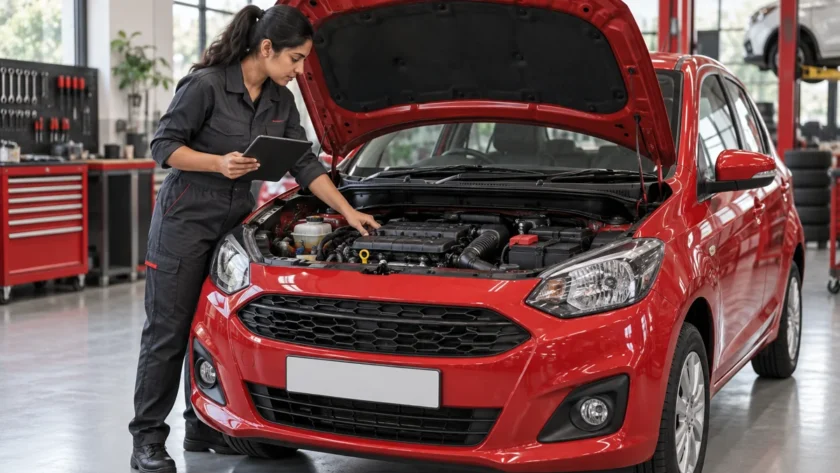
11. Arrange an independent inspection
Request a written assessment covering mechanical condition, underbody, structural concerns and diagnostic faults where appropriate. Manufacturer-backed inspection programmes also examine multiple systems; for example, Maruti Suzuki True Value describes checks across mechanical and electrical categories. That programme does not imply that a Car Kharidoo listing has the same certification.
12. Agree the handover in writing
Record the agreed price, disclosed faults, included items and responsibility for outstanding work and paperwork. Retain payment evidence and a dated handover record. Do not let a time-limited offer replace inspection or document verification.
Frequently asked questions
Can I inspect a used car myself?
You can complete initial visual and equipment checks. A professional assessment is still useful for faults that require tools, lifting equipment or technical experience.
Should I reject every repainted car?
No. Cosmetic repainting and structural repairs are different issues. Ask what happened and have the repair quality assessed.
What if the seller refuses inspection?
Without an independent assessment, you cannot resolve important condition questions. Consider another listing rather than paying while those questions remain open.
Ready to shortlist? Browse cars on Car Kharidoo and compare your options using our ₹5 lakh buying guide.